

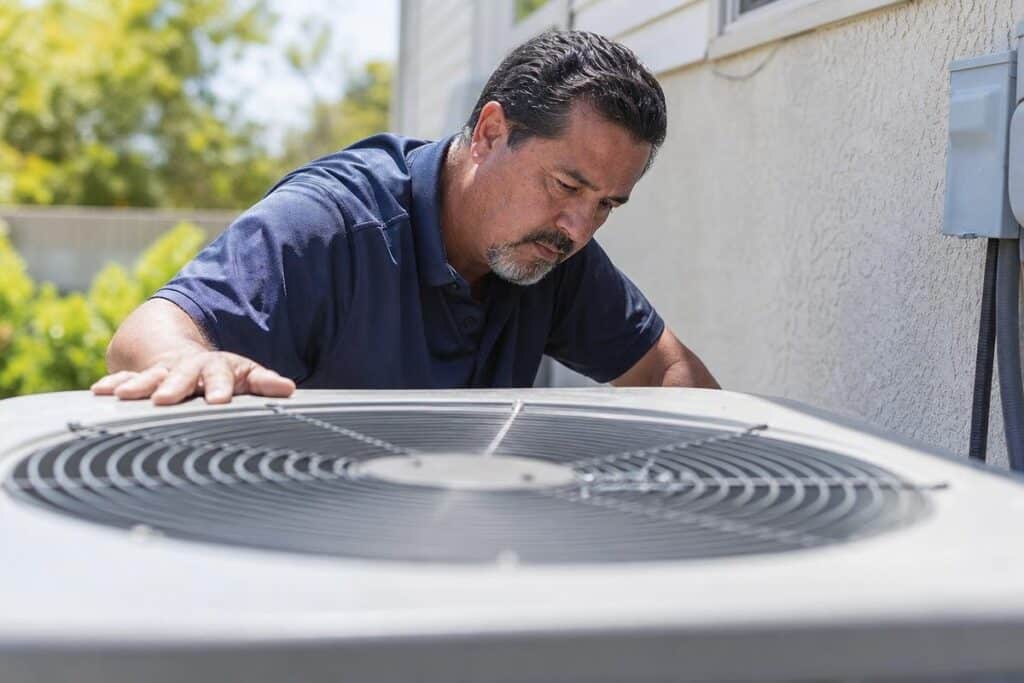
If you live in Murrieta or anywhere in the Murrieta to Temecula corridor, you already know summer heat hits differently here. Temperatures push past 100°F for weeks at a time, and your AC works overtime to keep up. But if your electric bill keeps climbing and you’re wondering why your AC bill is so high, Southern California’s brutal summer heat is only part of the answer. A dirty system, refrigerant leak, or aging equipment can quietly double your cooling costs. We Care Plumbing, Heating and Air has been diagnosing exactly these problems for local homeowners since 2000.
Get to the bottom of your high AC bill before next month’s statement arrives.
Key Takeaways
- High AC bills in Southern California are often caused by equipment problems, not just hot weather or utility rates.
- Dirty condenser coils, refrigerant loss, and aging systems force your AC to log excess runtime and use more electricity.
- Southern California Edison’s Time-of-Use rates charge peak prices from 4 PM to 9 PM, so an inefficient system costs you even more during those hours.
- Many Murrieta homes built before 2005 have original AC systems that are now 20-plus years old and well past peak efficiency.
- A professional AC inspection can pinpoint the exact reason your cooling costs are high and give you a clear fix.
If you live in Southwest Riverside County and your SCE bill jumped $100 or more this past July, you are not imagining things. Homeowners in Menifee, French Valley, and nearby communities are opening summer electric bills that feel completely out of control.
The easy answer is to blame the heat. But outdoor temperatures alone rarely explain a sudden spike. Most of the time, something specific is driving those extra kilowatt hours, whether that is a struggling AC system, habits in the home, or rate changes from your utility provider.
This guide covers all three. We look at equipment problems that make your system work harder than it should, home and lifestyle factors that quietly add to your cooling costs, and how to know when it is time to call a technician. Our NATE-certified, EPA 608 certified technicians see these same causes repeat every summer. Understanding them is the first step to getting that bill back down.
Why Southern California Summers Hit Your Electric Bill Harder Than You Think
Inland valley temperatures regularly exceed 100°F while SCE charges peak rates during the hottest hours of the day, a combination that forces your AC to work hardest when electricity costs the most. Homes in Carlsbad, just 30 miles west, see summer highs 20 to 25°F cooler than Menifee on the same day, yet run their AC only a few hours. That difference is not a coincidence: two separate forces are working against you, the physics of inland heat and the way your utility charges for power.
The Inland Valley Heat Factor
This part of SoCal sits at roughly 1,100 feet elevation, and zip codes 92562 and 92563 regularly see summer highs between 95 and 105°F. That gap of 20 to 25 degrees over coastal areas is enormous for your AC system.
Every AC unit is sized to a “design temperature,” the outdoor high it was built to handle before it starts struggling. When a multi-day heat event pushes temperatures past that threshold, your system cycles almost continuously. It never shuts off overnight because nighttime lows stay too warm to let the house recover. That means your system logs 16 to 20 hours of runtime on days it was only designed to handle 10. Poor attic insulation in pre-2005 homes makes this worse. An attic insulation inspection can tell you if your home is losing cooled air before it even reaches your living space. Check our summer energy-saving tips for HVAC systems for practical steps you can take right now.
How SCE Time-of-Use Rates Multiply the Problem
Southern California Edison’s default Time-of-Use rate plans charge their highest rates from 4 PM to 9 PM in summer. That five-hour window is also the hottest part of the day inland, which means your system runs its hardest exactly when electricity costs the most.
The fix is straightforward. Pre-cool your home before 4 PM by setting your thermostat lower in the morning and early afternoon. Then raise the setpoint during peak hours so the system runs less when rates are highest. It won’t eliminate the problem if your equipment has underlying issues, but it cuts your bill immediately. For a broader look at how rate structures and equipment efficiency connect, our guide to California energy efficiency updates for the HVAC industry breaks it down in plain terms.
5 AC System Problems That Drive Up Your Electric Bill
Your utility rate is not always the main villain. In many homes across Menifee, Temecula, and the surrounding area, the AC system itself is why homeowners ask why their air conditioner runs all day. Here are the five most common equipment problems we find when homeowners call us about a high electric bill.
- Dirty or clogged air filter restricting airflow
- Low refrigerant causing the system to log excess runtime
- Dirty condenser coils reducing heat transfer
- Aging or undersized system working beyond its capacity
- Leaky or poorly insulated ductwork wasting conditioned air
Dirty or Clogged Air Filter
Yes, your air filter really can drive up your bill. A clogged filter blocks airflow, which forces the blower motor to work harder and longer to push cool air through your home. MERV 8 to 11 filters strike the right balance between airflow and air quality. Go higher than MERV 13 and you may actually restrict airflow too much for a standard residential system.
The inland environment is dusty. Greer Ranch and French Valley homeowners deal with more particulates in the air than coastal communities do. That means monthly filter checks during summer, not the standard 90-day cycle. Pull the filter out and hold it up to the light. If you cannot see light through it, replace it today. A clean filter also supports a better indoor air quality assessment throughout your home.
Low Refrigerant Levels
Refrigerant is what your AC uses to absorb heat from inside your home and release it outside. When the level drops, the system loses its ability to cool efficiently. It cycles more frequently, works harder, and still cannot reach your thermostat setting. Signs to watch for include ice forming on the refrigerant line, warm air blowing from your vents, or a hissing sound near the outdoor unit.
Low refrigerant almost always means a leak somewhere in the system. Topping it off without fixing the leak is a short-term patch that wastes money. A licensed, EPA 608 certified technician is required by law to handle refrigerant. If you notice any of these signs, schedule air conditioning repair before the problem gets worse.
Dirty Condenser Coils
The condenser unit sits outside and dumps heat from your home into the outdoor air. When the coils get coated in dust, cottonwood, or debris, that heat transfer slows down and the system struggles to keep up. In this region, cottonwood season hits hard in late spring, right before peak cooling demand arrives.
You can rinse the fins gently with a garden hose after powering the unit off. That helps with surface buildup. But air conditioning maintenance reaches deeper into the coil and clears buildup that a garden hose cannot touch. Scheduling one before summer starts is the single best preventive step you can take.
An Aging or Undersized System
Older systems rated at SEER 10 to 12 (SEER is a measure of cooling efficiency) use significantly more electricity than modern equipment rated at SEER 15 and above. In our service calls across Murrieta and Menifee, we frequently find original systems in homes built during the 1990s to 2004 housing boom, now 20-plus years old. A system that runs continuously without reaching your thermostat setpoint is burning energy without delivering comfort.
An undersized system has the same problem. It simply does not have enough capacity for your home’s square footage. If your bill keeps climbing every year and your home never quite cools down, the system itself may be the answer. Read our guide on how to choose an energy-efficient AC unit to understand your options.
Not sure whether your system is the problem? Find out with a professional diagnosis.
Leaky or Poorly Insulated Ductwork
Studies consistently show that 20 to 30 percent of conditioned air can be lost through leaky ducts before it ever reaches your living space. Two-story homes with duct runs through hot attics face an added problem. In summer, attic temperatures in local homes can exceed 140°F. Cold air traveling through uninsulated ducts in that environment warms up fast.
Many pre-2005 homes here fall short of current attic insulation standards. If your upstairs rooms are always warmer than your downstairs, leaky or under-insulated ducts are a likely cause. An attic insulation inspection can show you exactly where you are losing conditioned air and money.
Home and Habit Factors That Add to Your Cooling Costs
Your AC system is not the only thing driving up your bill. How you set your thermostat, how well your attic is insulated, and how much heat sneaks in through windows and doors all push your system to work harder. These are things you can address this week, before calling anyone.
Thermostat Settings and Setback Schedules
Keeping your home at 72°F all day during a local summer is expensive. Every degree you raise the setpoint above 78°F saves roughly 3% on cooling costs. That adds up fast when outdoor temps hit 100°F across Menifee and Temecula-area neighborhoods.
A smarter approach is pre-cooling. Drop your home to 76°F before 4 PM, then let it drift up to 78 or 79°F during SCE’s peak rate window from 4 PM to 9 PM. You stay comfortable and avoid the highest-cost electricity of the day. Also check your thermostat for calibration issues. A faulty or mis-wired thermostat can keep your system running well past the point your home is actually cool, and most homeowners never suspect it.
Attic Heat and Insulation Gaps
Attic temperatures in this region reach 140 to 160°F on summer afternoons. That heat radiates straight down into your living space. California Climate Zone 10 requires R-38 to R-60 attic insulation under current Title 24 standards, but many homes built before 2005 fall well short of that. If your home was built in the 1990s or early 2000s, there is a real chance your attic insulation is the reason your AC never seems to catch up. Scheduling an attic insulation inspection is one of the most practical first steps you can take.
Windows, Doors, and Air Sealing
Single-pane windows and gaps around doors, recessed lights, and attic hatches are common in older homes here. West-facing windows are especially problematic because they take the full force of afternoon sun. Blackout curtains, solar shades, and basic weatherstripping are low-cost fixes that reduce the heat load your system has to fight every afternoon.
If you have addressed your thermostat habits and sealed obvious gaps and your bill is still high, that points toward a system issue worth having a technician look at.
When Should You Call an HVAC Technician About Your Electric Bill?
Some cooling problems you can fix yourself: a dirty filter, a blocked vent, a thermostat set wrong. But other problems need a trained technician. Knowing the difference saves you money and keeps a small issue from turning into a full system failure.
Signs the Problem Is Beyond a DIY Fix
Run through this checklist. If one or more of these applies to your home, stop troubleshooting on your own and call a pro.
- Your electric bill jumped 25% or more compared to the same month last year, with no rate change from SCE.
- Your air conditioner runs for 20 or more minutes without reaching the temperature you set.
- You see ice forming on the refrigerant line or indoor coil. That points to low refrigerant or a blocked airflow problem.
- You hear hissing, banging, or grinding sounds from the unit. Hissing often means a refrigerant leak.
- Your system is 12 or more years old and has not had a professional service visit in two or more years.
- Rooms that used to cool down easily are now noticeably warmer than the rest of the house.
If any of these sound familiar, read up on common HVAC problems homeowners face before you call, so you can describe the symptoms clearly when you do.
What a Professional AC Tune-Up Actually Checks
A real air conditioning maintenance visit is not just a filter swap. Our NATE-certified technicians work through a full checklist on every visit.
- Refrigerant level check and leak inspection
- Condenser and evaporator coil cleaning
- Electrical connection tightening and capacitor testing
- Blower motor and belt inspection
- Thermostat calibration
- Drain line flush, which matters especially during humid summers when drain pans can overflow
- Full system efficiency report so you know exactly where your system stands
Our technicians explain each step as they go. No guesswork, no vague answers. With more than two decades serving homeowners in this area, we diagnose the root cause rather than just treating symptoms. Want to understand what separates a thorough inspection from a basic visit? See why using a PEARL-certified HVAC technician is worth every penny.
If your air conditioner is running all day and your bill keeps climbing, it is time to find out why. Reach out to schedule an AC tune-up in the Murrieta area.
Could a New, More Efficient System Actually Save You Money?
Yes, a new system can pay for itself, but only if the math works in your favor. If your current unit is 15 or more years old and your summer cooling bills are climbing well past $200 a month, replacing it is worth running the numbers. A newer, more efficient system running at lower cost every month starts closing the gap on its own purchase price faster than most homeowners expect.
Understanding SEER Ratings and What They Mean for Your Bill
SEER stands for Seasonal Energy Efficiency Ratio. Think of it as miles per gallon for your AC: it measures how much cooling you get for every unit of electricity the system consumes over a full season. The higher the SEER, the less electricity the system burns to keep your home cool.
A SEER 10 system uses roughly 40% more electricity than a SEER 16 system to produce the same amount of cooling. That gap shows up directly on your bill every month from June through September. As of 2026, the federal minimum for new installations in our region is 15 SEER2 (the updated federal standard). Modern high-efficiency systems reach 18 to 20 SEER. If you want to dig deeper into your options, our guide on choosing an energy-efficient AC unit walks through the key decisions.
The math is straightforward. If your old system costs $200 a month in summer and a new high-efficiency unit brings that to $130, you are saving $70 a month during peak season. Over several cooling seasons, that adds up toward the replacement cost.
Heat Pumps as a High-Efficiency Alternative
Heat pumps are worth a serious look for homeowners here. They handle both cooling and heating from one system, and they can reach efficiency levels equivalent to SEER 18 to 22. In areas with mild winters like Menifee and the Temecula Valley, a heat pump rarely needs to work hard in the cold months, which makes it a practical year-round fit. Federal tax credits under the Inflation Reduction Act may reduce upfront costs for qualifying heat pump installations. Check current eligibility requirements with your tax advisor. If the purchase price is still a concern, look into financing your new HVAC system to spread the cost over time. Our team handles heat pump installation across the region and can tell you quickly whether your home is a good candidate.
What Murrieta Homeowners Should Know About Cooling Costs Specifically
If your electric bill feels out of control every summer, there is a geographic reason for that. Zip codes 92562 and 92563 sit at roughly 1,100 feet elevation, surrounded by the Santa Rosa Plateau foothills. That location means summer afternoon highs regularly hit 95 to 105°F, while coastal cities like Encinitas might be 10 to 15 degrees cooler at the exact same hour. Your AC is working harder than almost any system in the region.
Local Climate and Your AC Runtime
The inland heat is not just uncomfortable. It pushes cooling systems past the conditions they were designed to handle. July and August afternoons regularly exceed what most residential AC equipment considers its rated operating range. Homes along the I-15 corridor and in newer developments with minimal tree canopy face additional solar heat gain on roofs and walls, which raises indoor temperatures even faster.
That extra runtime adds up fast, especially under peak-rate pricing from 4 PM to 9 PM on summer weekdays. A system that is already struggling to keep up logs excess runtime during the most expensive hours of the day. Our air conditioning maintenance checks for exactly this kind of efficiency loss before it shows up on your bill.
Older Homes and Hidden Efficiency Drains
Neighborhoods like Spencer’s Crossing and Bear Creek include many homes built between 1990 and 2005. Those homes are now carrying original AC systems 20-plus years old, duct systems that were never resealed, and attic insulation that has settled well below current Title 24 standards. Zone 10 requires R-38 to R-60 attic insulation, and many pre-2005 homes fall significantly short. An attic insulation inspection can show you exactly where your home is losing the cooling battle before you pay for it another summer.
Having served this area since 2000, we have seen firsthand how these homes age. A whole-home efficiency review covers your equipment, ducts, and insulation together, giving you a clear picture of where your money is actually going.
Frequently Asked Questions
What is a normal electric bill for a home in the inland valley during summer?
For a home between 1,800 and 2,400 square feet on an SCE Time-of-Use rate plan, July and August bills typically run $250 to $450. Homes with older systems or thin attic insulation often push past $500. If your neighbors are paying significantly less for a similar-sized house, the gap usually points to equipment efficiency or insulation, not just the weather.
How much does a dirty filter actually affect my bill?
A severely clogged filter forces the blower motor to work harder, which can increase its energy draw by 15 to 25 percent. During peak cooling season in a dusty inland environment, check your filter every 30 days. A clean filter is the cheapest AC tune-up in Temecula or Lake Elsinore you will ever do.
How do I know if my system is low on refrigerant?
Watch for these signs: the system runs a long time without reaching your set temperature, you see ice forming on the copper line near the indoor unit, the vents blow warm, or you hear hissing near the outdoor unit. Only a licensed technician can legally recharge refrigerant. Our air conditioning repair team handles this start to finish.
Is it worth repairing my old AC or should I replace it?
A simple rule: multiply the repair cost by the system’s age in years. If that number tops $5,000, replacement is usually the smarter financial move. Newer systems qualify for rebates and federal tax credits, and our air conditioning installation team can walk you through the options. You can also read more about choosing an energy-efficient AC unit before you decide.
Does your team serve my neighborhood?
We serve Temecula, Menifee, Lake Elsinore, Wildomar, and surrounding Southern California communities. If your high electric bill has you wondering where to start, reach out or schedule online. We Care Plumbing, Heating and Air has been solving high-bill problems for local homeowners since 2000. Our NATE-certified technicians will check the system, explain exactly what they find, and give you a clear path to lower bills before next summer’s heat arrives.
Ready to Get Started with We Care Plumbing, Heating and Air?
Reach out to speak with our team directly. We’re ready to answer your questions, walk you through your options, and help you find the right solution for your needs. Whether you’re just starting to plan or ready to move forward, we’ll make the process simple and stress-free.
Reach out today and let’s talk about how we can help.