

Sewer line problems don’t always announce themselves with a burst pipe or a flooded yard. Sometimes it’s a slow drain, a strange gurgle, or a patch of grass that looks a little too green. At We Care Plumbing, Heating and Air, we’ve been diagnosing and fixing sewer issues for Southern California homeowners since 2000. If you’re seeing any of the warning signs below, read this before the problem gets bigger and more expensive to fix. Think you have a sewer issue? Get answers fast.
Key Takeaways
- Multiple slow drains at the same time often point to a main sewer line problem, not just a single clog.
- Homes in Murrieta and Temecula built before 1985 may have original clay or ABS sewer laterals that are past their design lifespan.
- Tree roots from eucalyptus and ficus are among the most aggressive causes of sewer line damage in Southern California.
- A camera inspection is the only way to know for certain whether you need a repair or a full sewer line replacement.
Why Sewer Line Problems Are Harder to Spot Than You Think
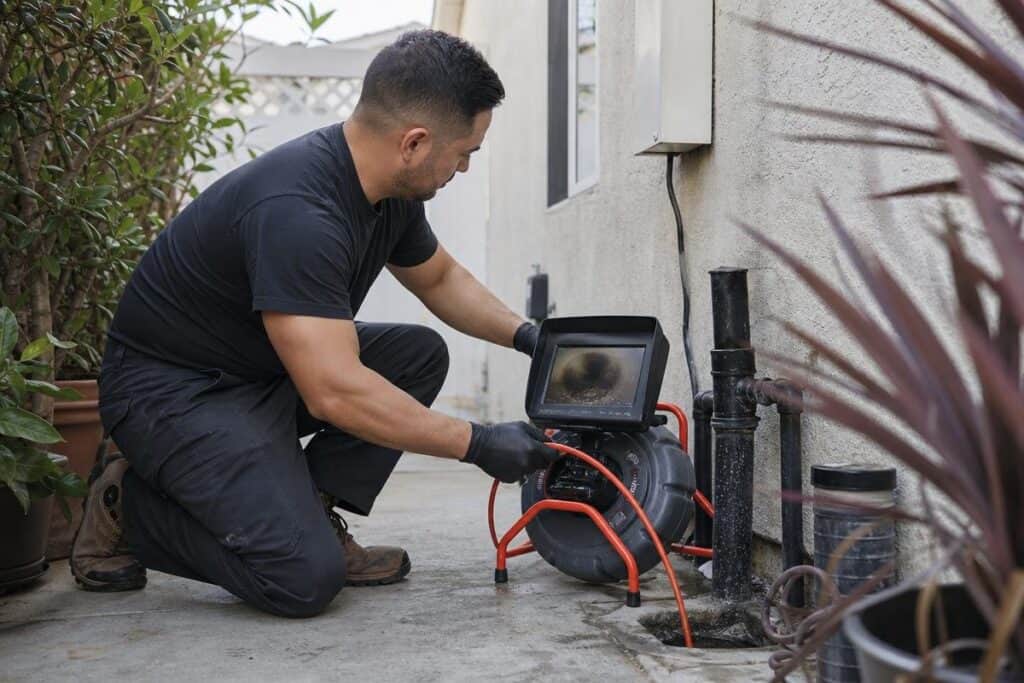
It started with a slow drain in the hall bathroom. No big deal, right? Then the kitchen sink backed up. A week later, there was a sewage smell near the back patio. A plumber ran a camera and found months of root intrusion in the main sewer line. What looked like a minor nuisance was a serious problem the whole time.
That story plays out regularly in homes across Southern California, from Murrieta and Temecula to San Marcos, Orange, and beyond. Sewer line problems build quietly. They mimic small inconveniences until the damage is significant and the repair bill is much larger.
Homes built along the I-15 corridor in the 1980s and early 1990s face real risk. Aging clay and cast-iron pipes, expansive soils, and mature tree canopies all stress lateral sewer lines across our service area.
We Care Plumbing, Heating and Air. Below are 8 specific red flags that point to the main sewer line, not just a single branch clog. Check out our full plumbing services if you need help beyond what you read here.
How a Main Sewer Line Actually Works
Every drain in your home feeds into one main lateral line. That single pipe runs underground from your foundation to the city sewer main or your septic system. Your kitchen sink, bathrooms, laundry room, all of it flows through that one line.
That’s why sewer line problems look different from a regular clog. A single slow drain usually means a local blockage. But a partial collapse or crack in the main lateral affects every fixture at once. That’s the key distinction. If multiple drains are sluggish or backing up together, the problem is almost certainly deeper than your drain trap.
What Makes Southern California Homes Especially Vulnerable
Three local factors make underground pipe failures more common here than in many other parts of the country.
- Soil movement. Murrieta and the surrounding I-15 corridor sit on clay-rich expansive soils. These soils swell in wet winters and shrink in dry summers. That constant movement shifts underground pipe joints, especially in pre-1990s clay or cast-iron laterals, causing cracks and separations over time.
- Tree root intrusion. Mature eucalyptus, pepper trees, and Canary Island date palms are common in established neighborhoods and along Temecula’s wine country tracts. Their roots seek out any moisture source, including hairline cracks in your sewer pipe.
- Hard water and mineral scale. Riverside County water hardness typically runs 15 to 25 grains per gallon. That mineral load narrows pipe interiors over time and traps debris. Our water quality treatment options can help slow that buildup.
A professional plumbing inspection is often the best way to catch these issues before they become a costly repair.
Sign 1: Multiple Drains in Your Home Are Slow at the Same Time
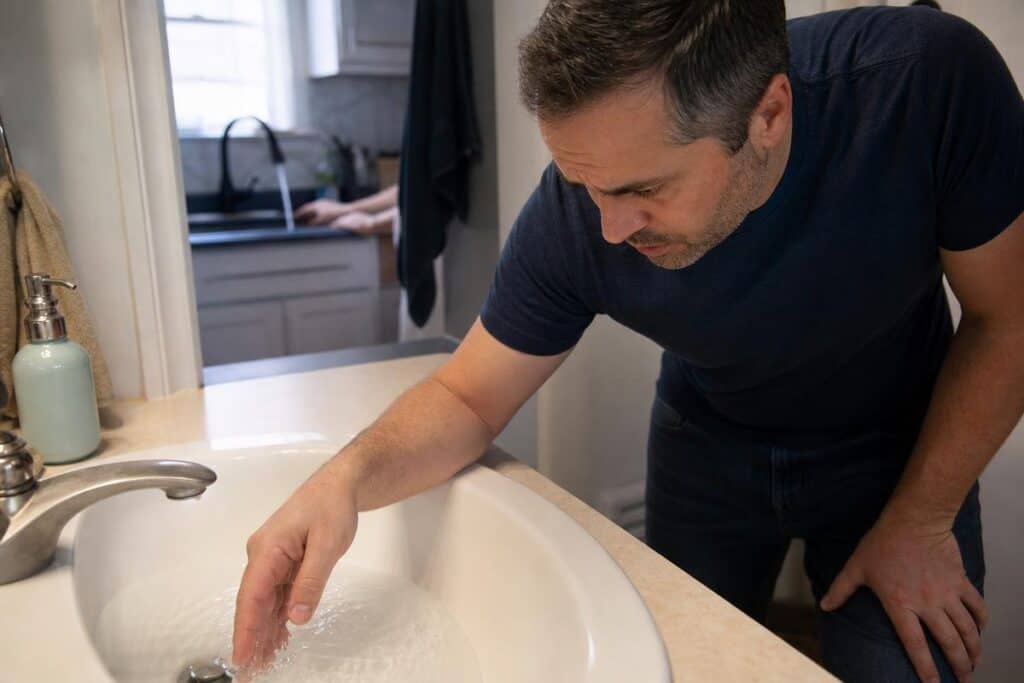
One slow drain usually means a localized clog, hair, grease, or soap buildup in that branch line. But when your kitchen sink, bathroom tub, and laundry drain all run slow at the same time, that points to a restriction in your main sewer line, not any individual fixture.
Here is a quick test you can do right now. Run your kitchen faucet for 30 seconds. Then walk to the hall bathroom and watch the floor drain or tub. If you see gurgling or water backing up, the problem is downstream in the main line. A plunger will not fix that. Store-bought drain cleaner will not either. Those only mask the symptom and delay a real diagnosis.
This is one of the earliest indicators you can catch on your own. Slow drains across multiple fixtures give you a window to act before a full backup happens. Homes in Murrieta’s older established tracts see this pattern often, partly due to the clay-rich soils and tree root pressure covered in the previous section.
If the test points to your main line, read what to do when drains are blocked before reaching for any quick fix. A professional plumbing inspection with a camera gives you a definitive answer, not guesswork.
Sign 2: Your Toilet Gurgles When You Run Water Somewhere Else
A gurgling toilet is one of the earliest red flags homeowners notice, and one of the most dismissed. Here is what is actually happening: a partial main sewer line clog traps air downstream. That trapped air has to go somewhere. It pushes back up through the nearest available vent, which is usually your toilet, and you hear a gurgle or see a bubble.
Try this right now. Run your bathroom sink for 60 seconds and watch the toilet bowl. Bubbles or gurgling mean trapped air from a restriction further down the line. A second version of this: run your washing machine and check the toilet in the nearest bathroom. Same gurgle, same cause.
Homeowners in older San Marcos tracts often write this off as a “toilet quirk.” It is not. It is one of the first signals that your main sewer line is narrowing from root intrusion or mineral scale buildup. Ignoring it now typically means a full backup later.
A main sewer line clog does not fix itself. If you are seeing this symptom, schedule a professional plumbing inspection before the problem gets bigger. Camera inspections show exactly what is inside the pipe, so there is no guesswork.
Sign 3: The Same Drain Keeps Clogging No Matter How Many Times You Clear It
We hear this one a lot from homeowners in Orange and around Murrieta. You clear the drain, it runs fine for two or three weeks, then it clogs again. That cycle is exhausting. And it usually means the drain snake is only clearing the symptom, not the actual problem.
A one-time clog is almost always localized debris. A drain that clogs repeatedly, despite plunging, store-bought cleaners, or a professional snake, points to something structural happening inside the pipe. There are three specific causes we look for:
- Partial root intrusion. Roots grow back after snaking. You clear them today, they return in weeks.
- A pipe belly. Soil settling creates a low spot where waste pools and accumulates. No amount of snaking fixes that.
- A partial collapse. The pipe diameter is permanently narrowed. Debris catches every time.
Homes in Murrieta built in the 1970s and 1980s often have original clay tile sewer laterals that are especially prone to both root intrusion and pipe belly. Our hydro-jetting service can clear root intrusions more thoroughly than a snake, but a camera inspection is the only way to confirm which of these three problems is causing your main sewer line clog. A professional inspection tells you exactly what you are dealing with before you spend another dollar on temporary fixes.
Sign 4: You Smell Sewage Inside or Outside Your Home
A working sewer line is a sealed system. Any sewage smell, indoors or out, means something in that system has failed. This is not a wait-and-see situation.
Smell Inside the House
A sulfur or rotten-egg odor near floor drains, laundry rooms, or lower-level bathrooms can sometimes trace back to a dry P-trap. Run water in that fixture for 30 seconds and see if the smell clears. If it does not, or if the smell shows up in multiple rooms, you are likely dealing with a crack or joint separation in the main line. Sewer gas is migrating into your home through that break. Sewer gas contains hydrogen sulfide and methane. Both are a health concern. At high concentrations, methane is a fire risk. Get it checked.
Smell Outside the House
Outdoor sewage odor, especially after rain, often means a crack or break is letting effluent seep into the surrounding soil. In the Wildomar and Lake Elsinore areas, we see this near landscaped side yards that run directly over the sewer lateral path. Wet-season soil saturation pushes the smell to the surface fast. That is one of the clearest signals of a compromised line you will encounter.
If you notice either of these symptoms, read our guide on what to do before the plumber arrives, then schedule a professional inspection right away.
Sign 5: Unusually Green, Soggy, or Sunken Patches in Your Yard
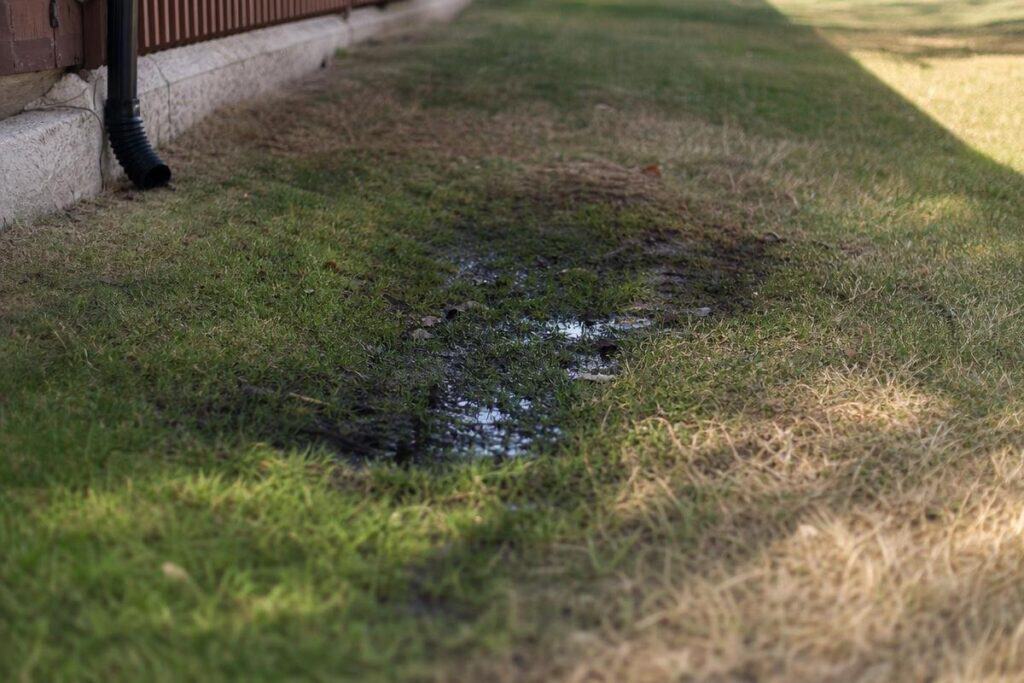
Your yard is telling you something. A strip of grass that stays bright green while the rest of your lawn turns brown in a dry Inland Valley summer is one of the clearest collapsed sewer line symptoms you can spot without any tools. That green strip follows the path of your sewer lateral, and it stays lush because cracked pipes are leaking nutrient-rich sewage directly into the soil below.
Soggy ground is the next warning. If a patch of your yard stays soft and spongy even when irrigation has not run, that moisture is coming from somewhere underground. In the clay-heavy soils common across Murrieta, a slow sewer leak saturates surrounding soil fast. Clay holds that moisture in, so the soft spot does not dry out the way sandy soil would.
The most serious version is sunken or depressed ground. A visible dip in your yard, especially along the path from your house to the street, often means a section of pipe has collapsed and the surrounding soil has eroded inward. That is a red flag that needs immediate attention.
Walk that lateral path from your foundation to the street. Look for any of these three things: an unusually green strip, a soft patch, or a ground depression. Then call us for a camera-based inspection to confirm the source before any digging begins. Our plumbing repair team can assess exactly what is happening underground.
Noticing soggy ground or a green strip in your yard? Visit our contact page before a slow leak becomes a full collapse.
Sign 6: Your Home Was Built Before 1985 and Still Has Original Pipes
Pipe age and material are two of the biggest risk factors for sewer line problems. Homes built before 1985 across Murrieta and Riverside County generally may still have original sewer laterals made from clay tile or Orangeburg pipe. Both materials are well past their design life by 2026.
Clay tile is durable but brittle. The joints between sections are the weak points. Roots enter those joints, grow fast, and can fill a pipe interior within a few years. Once that happens, you are looking at collapsed sewer line symptoms: slow drains, backups, and gurgling fixtures throughout the house.
Orangeburg pipe is worse. It is a tar-and-paper composite used through the mid-1970s. It softens and deforms over time. Any Orangeburg lateral still in the ground today has almost certainly lost its round shape and is partially collapsed. There is no cleaning or patching that fixes this. Replacement is the only real answer.
ABS plastic pipe, common in 1980s Inland Valley construction, can also develop joint failures. Soil movement stresses the connections over decades, especially in areas with clay-rich ground. If you do not know what your sewer lateral is made of, an inspection with a sewer camera will show you in about an hour. You can also read more about plumbing issues in older Murrieta-area homes to understand what to watch for.
Sign 7: Large Trees Are Growing Within 50 Feet of Your Sewer Line
Any tree with an aggressive root system within 50 feet of your sewer lateral is a real threat, even if the pipe shows no symptoms yet. Roots follow moisture. Your sewer line is a constant water source underground, and roots will find it.
In established Murrieta neighborhoods, we see this constantly. Eucalyptus trees have some of the most aggressive root systems around. Ficus trees, widely planted as street trees in Orange, are just as destructive. Canary Island date palms spread roots wide and shallow. Even crape myrtles can push into a cracked clay lateral.
Here is how the damage builds. A small root tendril finds a hairline crack and enters. It grows. The crack widens. More roots follow. Eventually you have a partial or full blockage from a dense root mass inside the pipe.
Hydro-jetting to clear root intrusions works well, but it only removes what is there today. If the underlying crack stays unrepaired, roots grow back within 12 to 18 months. Clearing without repairing is a temporary fix.
Your action step: walk your yard. Locate the main cleanout near your foundation and trace the line toward the street. If a mature tree falls within that corridor, schedule a sewer line inspection before roots turn a small crack into a collapsed pipe.
Sign 8: You Notice Foundation Cracks, Pest Activity, or Unexplained Water Bills
These three signs look completely unrelated. A crack in the drywall, a roach in the kitchen, a water bill that jumped $40. Experienced plumbers see them together all the time, and they often share one cause: a sewer line leaking underground.
Foundation Cracks Near the Sewer Lateral Path
A slow underground leak saturates the soil beneath your slab. In Murrieta, where many homes sit on expansive clay over concrete slabs, that moisture causes one section to settle while the rest stays put. The result is hairline cracks in drywall near door corners, doors and windows that suddenly stick, and visible cracks along the slab itself. These are classic collapsed sewer line symptoms that homeowners mistake for normal settling. Our plumbing repair services include slab leak detection to find the source before the damage spreads.
Rodents and Insects as an Unexpected Indicator
A cracked sewer lateral is an open door. Rats and cockroaches follow sewer systems underground, and a break in the pipe gives them a direct path into wall cavities and crawl spaces. If you have a sudden rodent or roach problem with no obvious exterior entry point, a cracked sewer line is a real suspect. Pest control companies across the region are increasingly aware of this connection.
A Water Bill That Keeps Climbing
A sewer line leak does not directly raise your water consumption. But a supply line leak near the sewer lateral path is easy to confuse with a sewer issue, and vice versa. If your bill is climbing with no change in habits, inspecting both at the same time is the smart move. Read our guide on how to detect plumbing leaks in your home to know what to look for before you call. Seeing more than one of these signs? Talk to a plumber today.
What to Do When You Spot These Signs Across Southern California
Spotting one or more of these signs means it’s time to act, not wait. The local clay soils and aggressive root pressure we covered earlier move fast. Here’s exactly what to do.
Step 1: Stop Using the Affected Fixtures
If multiple drains are backing up or you smell sewage, stop running water immediately. Every flush or sink load pushes more water into a line that may already be blocked or broken. That can force sewage up through floor drains, tubs, or toilets, and cleanup gets much harder from there. Read our guide on what to do before the plumber arrives while you wait.
Step 2: Call for a Camera Inspection, Not Just a Snake
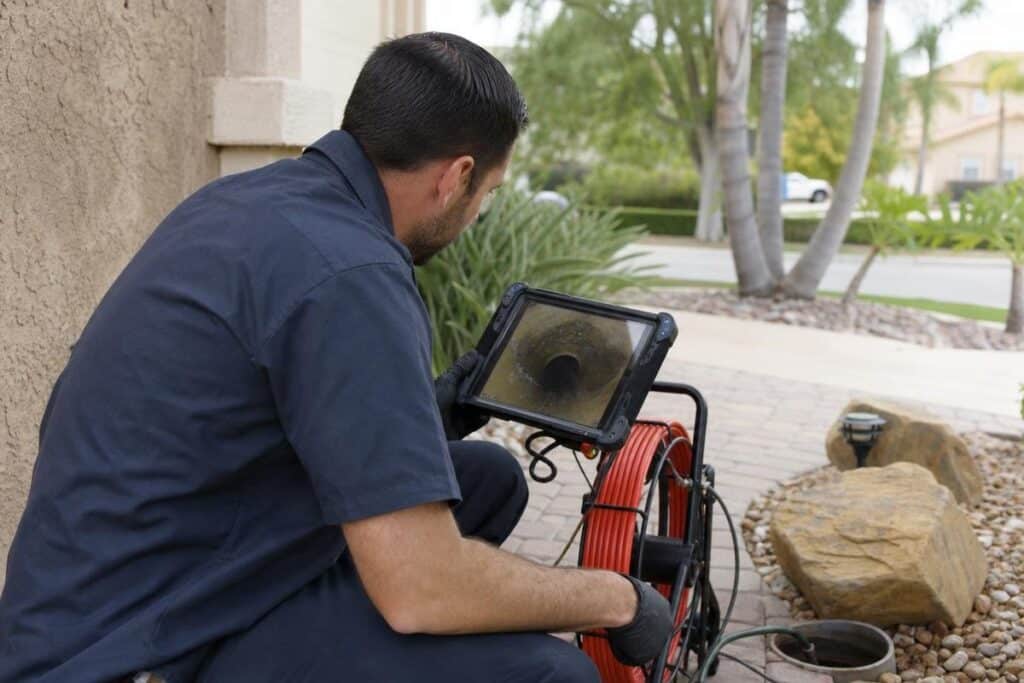
A drain snake clears a clog. It does not show you what caused it. A video camera inspection runs a waterproof camera through your sewer lateral and shows root intrusion, pipe belly, crack locations, pipe material, and joint separation in real time. That footage tells us whether you need cleaning, spot repair, pipe lining, or full replacement.
Our team provides professional inspections for homeowners across the Inland Valley and North County. Understanding why regular plumbing inspections matter can save you from a much bigger repair bill later.
Step 3: Understand Your Repair Options Before Work Begins
There are four main approaches, and the camera footage tells us which one fits your situation.
- Hydro-jetting: High-pressure water clears root mass and mineral scale. Good for lines that are intact but obstructed. See our hydro-jetting service for details.
- Pipe lining (CIPP): A resin-coated liner cures inside a cracked but structurally sound pipe, creating a new pipe within the old one. No full excavation needed.
- Pipe bursting: A new pipe is pulled through while the old one is fractured outward. Full replacement without a full trench.
- Open-cut replacement: Used when a section has fully collapsed. The damaged segment is excavated and replaced.
Our technicians walk you through findings and options clearly before any work begins. Customers consistently note that our team “took the time to explain everything” without any pressure.
Frequently Asked Questions
How do I know if my sewer line is broken or just clogged?
One slow drain is usually a branch-line clog. Multiple slow drains at once, a gurgling toilet when you run the sink, or a sewage smell inside your home all point to the main sewer line. A camera inspection is the only way to know for certain. Our team can show you the footage in real time.
How much does sewer line repair cost in Murrieta, CA?
Cost depends on the repair method, pipe depth, and how much of the lateral needs attention. Hydro-jetting to clear root intrusions costs far less than full pipe replacement. We always do a camera inspection first so you get clear options, not guesswork.
Can tree roots really destroy a sewer line?
Yes, and faster than most homeowners expect. A root tendril entering a hairline crack in clay or cast-iron pipe can fill the entire pipe interior within a few years. Ficus and Eucalyptus species are especially aggressive. Catching root intrusion early means hydro-jetting service is often all you need.
How long does a sewer line camera inspection take?
Most residential inspections take between 45 minutes and 2 hours. It depends on lateral length and cleanout access. You watch the footage live and leave knowing exactly what is inside your pipe.
Is sewer line repair covered by homeowners insurance in California?
Standard California homeowners insurance typically does not cover repairs caused by root intrusion, wear, or age. Some policies offer a service line rider as an add-on. Sudden, accidental damage may be covered. Check your policy and ask your insurer specifically about service line coverage.
How often should I have my sewer line inspected in Southern California?
Homes built after 1990 with no known issues: every 3 to 5 years is a reasonable baseline. Homes built before 1985, homes with large trees near the lateral, or homes with recurring sewer line problems: annual inspections are worth it. Read why regular plumbing inspections matter for a full breakdown.
Spotted one of these red flags in your home? Do not wait for a second symptom to confirm it. Call us at (951) 277-6848 or visit our contact page to schedule a sewer line inspection in Murrieta, Temecula, San Marcos, or Orange, CA. We will show you exactly what is happening in your pipes before recommending any repair. No guesswork. No pressure. Just a clear picture of what your sewer line actually needs.
Ready to Get Started with We Care Plumbing, Heating and Air?
Call (951) 277-6848 or visit our contact page to speak with our team directly. We’re ready to answer your questions, walk you through your options, and help you find the right solution for your needs. Whether you’re just starting to plan or ready to move forward, we’ll make the process simple and stress-free.
Reach out today and let’s talk about how we can help.