

Temecula summers are no joke. Peak afternoons in the Inland Valley regularly climb into the range of 103 to 108°F, and an air conditioner that’s the wrong size will either run nonstop or short-cycle, leaving you hot and paying more than you should. We Care Plumbing, Heating and Air has served the Inland Valley since 2000, and proper AC system sizing is one of the first things we check before recommending any equipment.
We don’t guess at load. We calculate it, based on your actual home, your zip code, and your local climate. Think your AC might be the wrong size for Temecula heat? Let’s find out.
Key Takeaways
- Temecula’s inland heat zone regularly peaks at 103 to 108°F in summer, making accurate AC system sizing more critical here than in coastal SoCal cities.
- A unit that’s too large or too small will cost you more money and fail sooner than a correctly sized system.
- Proper sizing uses a Manual J load calculation, not just square footage, to account for ceiling height, insulation, and window exposure.
- Homes in newer Temecula communities with open floor plans and west-facing glass often need more cooling capacity than basic size charts suggest.
Is Your AC Sized Right for Inland SoCal Heat?
If your house is still hot and sticky at 3 p.m. with the AC running all day, the thermostat is not the problem. The system is probably the wrong size for your home. That is one of the most common issues we see across Temecula and the surrounding Inland Valley every summer.
Inland SoCal is not the coast. The Pacific marine layer that keeps beach cities mild through July and August simply does not reach the valley floor here. That changes everything about how your AC needs to be sized. Check out our summer energy-saving tips for your HVAC system for ways to reduce the load while you sort out the sizing question.
Our team has been sizing and installing AC systems across Temecula and Murrieta since 2000. Below, we explain how AC system sizing actually works, why square-footage rules fall short here, and what a proper load calculation covers so you can make a confident decision.
Why AC Unit Size Matters More in Inland Southern California
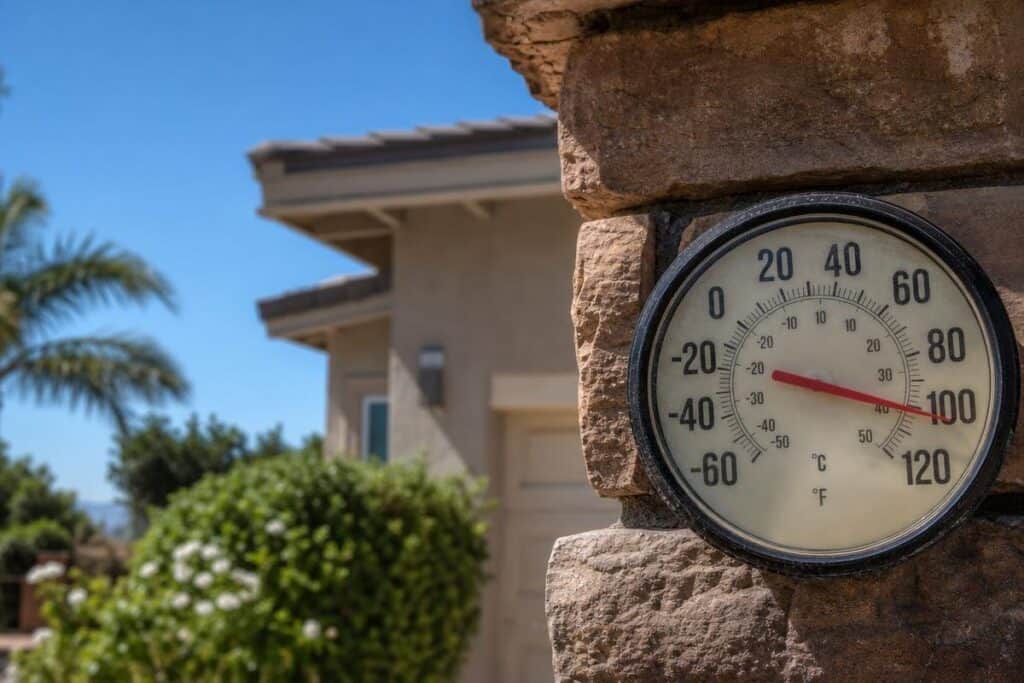
Coastal cities get a steady break from the Pacific marine layer, so their summer highs stay in the 70s and 80s. Temecula sits well past that transition zone, where the marine influence fades fast. The Inland Valley corridor where we work every day hits those triple-digit peaks for hours at a stretch, and late-summer monsoon moisture piles humidity on top of the heat. A sizing error that causes only mild discomfort in a coastal neighborhood can make an inland home unlivable. That is why load calculation accuracy in this region is not a detail you can skip.
In our 25 years of service calls across the valley, we’ve found that tract homes built during the Temecula and Murrieta building booms of the 2000s and 2010s often received builder-grade tonnage installs with no real load calculation behind them. Many of those systems are still running today, sized wrong from day one. That matters because equipment sizing in this climate is not forgiving. The margin between “comfortable” and “struggling to keep up” is measured in degrees and dollars.
What Happens When Your AC Is Undersized?
An undersized system runs continuously and still never reaches the thermostat setpoint. Picture a 2-ton unit in a 2,000 square foot home on a peak inland afternoon. The compressor works without a break, wearing down far faster than it should. Homeowners in this situation often call us thinking they need a refrigerant recharge or a repair.
Sometimes the real problem is that the unit was never big enough for the actual cooling load. A properly sized system, confirmed by a real load calculation, would have caught this before installation day. Read more about why working with a NATE-certified HVAC technician is worth every penny when sizing and installing equipment in a demanding climate like ours.
What Happens When Your AC Is Oversized?
An oversized unit short-cycles, cooling too fast and shutting off before it ever removes enough humidity. It blasts cold air, hits the setpoint in 8 to 10 minutes, then quits. The result is a home that feels clammy even when the thermostat reads 74°F. Room-to-room temperature swings are common too.
The constant start-stop cycling also stresses the compressor, shortening its life. If your home has large open floor plans or significant west-facing glass, those factors push your actual cooling load higher than square footage alone suggests. Poor attic insulation makes both problems worse by letting heat pour in from above.
What Is a Manual J Load Calculation and Do You Actually Need One?

Yes, you need one. A Manual J load calculation is the ACCA-standard method for sizing residential AC systems. It gives you a real number, not a guess. And in an inland valley climate where summer temperatures regularly push past 100°F, getting that number right is the difference between a system that keeps up and one that fails you in August.
What Manual J Actually Measures
A Manual J calculation looks at your home as a whole system. It measures actual cubic volume, not just floor area. It factors in your insulation R-values, window area, window orientation, and glazing type. It accounts for how many people live in the home, appliance heat gains, and your duct system efficiency. It also plugs in the local outdoor design temperature for your specific climate zone.
That last point matters a lot here. The design temperature input for Temecula and the inland valley is substantially higher than what you’d use for a coastal city. The output is a precise BTU-per-hour cooling load, which your contractor then converts to tons. One ton equals 12,000 BTU per hour. That final number is what your new system should be sized to, nothing more, nothing less.
Why ACCA-Member Contractors Use It and Others Skip It
ACCA members are required to perform Manual J calculations for new installations. Contractors who skip it and size by square footage alone are guessing. That guess almost always lands wrong in one direction or the other, either undersized so the system runs constantly, or oversized so it short-cycles and never removes enough humidity.
Our team holds the ACCA Contractor of the Year award, which means we follow these standards on every installation. We do not guess at system size. If you’re comparing contractors, that credential matters. Check out these tips for finding the best HVAC contractor before you sign anything. Knowing what questions to ask about sizing methodology can save you from a costly mistake.
Your attic insulation inspection is also part of this picture. Poor attic insulation inflates your actual cooling load and can make even a correctly sized system struggle on peak days.
Ready to get your home sized right? Call We Care Plumbing, Heating and Air at (951) 277-6848 or reach out online and we’ll schedule a proper load calculation, no guesswork involved.
The Square-Footage Rule-of-Thumb: Why It Fails Here
You’ve probably seen the online AC sizing calculator. Plug in your square footage, get a tonnage number, done. It feels easy. The problem is that number was built for a different climate entirely, and inland SoCal is not that climate.
What the Generic Sizing Charts Actually Assume
The standard rule says 1 ton of AC per 400 to 600 square feet. That ballpark estimate comes from a set of assumptions baked into the formula. It assumes moderate summer temperatures, around 85°F peak. It assumes 8-foot ceilings. It assumes standard insulation that is still performing well. It assumes average sun exposure hitting the home from multiple directions, not one brutal afternoon side.
None of those assumptions describe Temecula or the inland valley corridor. The formula was not designed for your home. It was designed for an average home in an average climate. That is a real problem when you are trying to figure out what size AC unit you need for a place that sees triple-digit peaks through July and August.
The Inland SoCal Variables That Change Everything
Here is what the generic chart never accounts for in this region.
- Design cooling temperature. The inland valley design cooling temperature runs around 105°F, while coastal Orange County sits closer to 85°F. That 20-degree gap means your system has to move significantly more BTUs just to hold 75°F inside. The rule-of-thumb ignores this completely.
- Attic heat load. Homes with dark tile or asphalt roofs see attic temperatures above 150°F on a hot afternoon. That heat radiates down into living spaces and drives up the real cooling load. If your attic insulation has degraded, the problem gets worse. An attic insulation inspection can tell you exactly how much heat you are fighting from above.
- West-facing glass. Newer master-planned communities in areas like Redhawk and Wolf Creek feature large open floor plans with significant west-facing windows. From roughly 2 p.m. to 7 p.m., those windows take direct afternoon sun. The solar heat gain is substantial and no generic size guide accounts for it.
- Duct losses. Builder-grade ductwork routed through unconditioned attics loses meaningful cooling capacity before air ever reaches your registers. In homes built during the 2000s and 2010s, that insulation has also degraded over time. You are paying to cool your attic, not your living room.
The right size air conditioner for an inland SoCal home is almost always larger than what the online calculator suggests. Undersizing means your system runs constantly and still cannot keep up on the hottest days. Oversizing causes short cycling, uneven comfort, and extra wear on the equipment. Neither outcome is acceptable. The only way to get the right number is to account for your actual home, not a national average.
How to Get a Ballpark AC Size Estimate for Your Home
Yes, you can work out a rough AC tonnage figure before calling anyone. It won’t replace a full load calculation, but it gives you a starting point so you’re not walking into the conversation blind. Here’s how we’d walk through it for a Temecula home.
A Simple Starting Formula for Inland SoCal Homes
Start with your conditioned square footage. That means interior living space only. Do not count the garage, unconditioned attic, or any storage area that isn’t cooled.
- Step 1: Measure conditioned square footage only. Pull your floor plan or check your property records. Subtract any space your AC doesn’t actually cool.
- Step 2: Apply the inland SoCal baseline. Use 1 ton per 400 sq ft, not the national average of 500 to 600 sq ft. Our peak-summer design temperatures were never accounted for in that national number.
- Step 3: Add 0.5 ton for heat-gain factors. Significant west-facing glass, a dark roof, or poor attic insulation all push your actual cooling load higher. If your home has two or more of these, add the half ton.
- Step 4: Subtract 0.5 ton for efficiency upgrades. Recently upgraded insulation, double-pane low-E windows, and well-shaded exposures reduce load. If you’ve done the work, you may be able to size down slightly.
Here’s a quick example. An 1,800 sq ft home in Redhawk with standard insulation and west-facing windows starts at 4.5 tons using this formula. A full Manual J might confirm 4 tons or push it to 5 tons depending on actual conditions. The ballpark gets you in the right range. It doesn’t get you to the right answer.
If you’re also evaluating a heat pump installation as an alternative to a traditional split system, the same sizing logic applies. Tonnage requirements don’t change based on equipment type.
When to Move Beyond the Estimate to a Full Manual J
A ballpark estimate is fine for general planning. It’s not fine for making a purchase decision. Move to a full Manual J in any of these situations:
- You’re buying a new system, not just swapping a same-size unit
- You’ve added a room, finished a bonus space, or re-insulated
- Your current system short-cycles or runs nonstop on hot days
- You’re considering a new heating system alongside the AC replacement
Our team includes the Manual J in every new installation. No guessing. No defaulting to “same size as before.” That’s how we’ve done it since 2000, and it’s the only way to get tonnage selection right in inland Southern California.
AC Sizing Across Temecula, Murrieta, and Neighboring Communities: What Changes by Location

Yes, your city’s climate directly affects what size AC you need. Design cooling temperatures, elevation, and proximity to the coast all shift the numbers in a Manual J calculation. A home in Temecula zip code 92592 and an identical home closer to the coast can end up needing different tonnage, even with the same square footage and floor plan.
Temecula and Murrieta: The Inland Valley Heat Corridor
Both cities sit in the same inland heat pocket, blocked from marine air by the Santa Ana Mountains and Palomar Mountain range. That means your AC has to work against extreme outdoor heat for hours at a time, not just during afternoon spikes.
Homes in master-planned communities like Wolf Creek often have open floor plans with 10-foot ceilings and significant west-facing glass. That extra cubic volume pushes tonnage requirements up, sometimes by half a ton compared to a smaller, older home with the same footprint. Our team serving plumbing, heating, and AC in Temecula accounts for these variables on every sizing visit. Neighborhoods on Temecula’s western slopes near wine country do catch slightly more afternoon breeze, which can modestly reduce the calculated cooling load.
Poor attic insulation makes the problem worse in both cities. If you have not had yours checked, an attic insulation inspection can reveal heat gain that changes your sizing math significantly.
San Marcos and Other Transitional Zones: Their Own Quirks
The sizing process is different in the coastal-inland transition zone, and that matters. Communities like San Marcos see summer highs that run 5 to 10°F cooler than the inland heat corridor. A comparable home there may calculate out to half a ton less capacity in a proper load calculation. Our HVAC services in San Marcos are calibrated for that difference.
Areas with even stronger marine influence, where design temperatures sit in the low-to-mid 90s, tend to see the opposite problem. Contractors trained in coastal markets sometimes underestimate short-cycling risk in moderate climates, leaving homeowners with a unit that cools too fast, shuts off early, and never pulls enough humidity out of the air. Location changes the right answer every time.
Frequently Asked Questions
How many tons of AC do I need for a 2,000 sq ft home in this area?
Start with 4 to 5 tons as a rough inland SoCal baseline. But that number shifts based on insulation quality, window orientation, ceiling height, and actual heat gain on a peak design day. A Manual J load calculation confirms the real number. Square footage alone will not get you there.
Does your team perform a Manual J calculation?
Yes, every time. We include a Manual J load calculation with every new system installation. As an ACCA Contractor of the Year, we are required to use it. No guesswork, no rule-of-thumb shortcuts.
Can I just replace my old AC with the same size unit?
Not necessarily. Many homes built during the early 2000s building boom in this area were installed with incorrectly sized systems. Repeating the same tonnage repeats the same problem. We always run a fresh load calculation before recommending a replacement size.
How does attic insulation affect what size AC I need?
Poor attic insulation can add thousands of BTUs of heat gain per hour on a hot inland day. That can push your required tonnage up by half a ton or more. Upgrading insulation before replacement sometimes allows a smaller, less expensive system. Our attic insulation inspection can tell you exactly where you stand before you buy.
What happens if my AC is oversized?
It short-cycles. The system cools the thermostat quickly, shuts off, and never runs long enough to pull humidity out of the air. During the monsoon humidity events that hit the inland corridor each summer, you end up at 74°F and still feel clammy. Compressor wear accelerates too.
How often should I have my system checked after installation?
Once a year before summer. Given the intensity of the cooling season here, that annual tune-up matters. Our VIP Club maintenance plan covers it. You can also review our year-end HVAC maintenance checklist to stay on top of things between visits. Homeowners in Corona and Chino Hills on the same plan tell us it is the single best thing they do for system longevity.
Ready to stop guessing and get the right size AC for your home? Call We Care Plumbing, Heating and Air at (951) 277-6848 or visit us at 27720 Jefferson Ave Ste 100, Temecula, CA 92590. Our team performs a full Manual J load calculation with every new AC system installation, so you get the right size the first time. No guesswork. No callbacks. Just a home that actually cools down.
Ready to Get Started with We Care Plumbing, Heating and Air?
Call (951) 277-6848 to speak with our team directly. We’re ready to answer your questions, walk you through your options, and help you find the right solution for your needs. Whether you’re just starting to plan or ready to move forward, we’ll make the process simple and stress-free.
Reach out today and let’s talk about how we can help size your system right.