


Temecula nights can drop into the 30s, and a furnace not working is not something you want to figure out at 10 p.m. We Care Plumbing, Heating and Air has been serving Temecula homeowners since 2000, and we know exactly what causes these systems to quit. Most of the time, it comes down to one of six common problems, and some you can check yourself right now. It’s a January morning, the thermostat reads 58 degrees, and you hear nothing from the furnace.
In inland Southern California that is a real problem, because overnight lows across Temecula, Murrieta, and San Marcos regularly slide into the 30s and 40s from November through February. This guide covers 6 common causes of furnace failure, what you can safely check yourself, and when to call a licensed pro. Furnace out? Our team is ready to help today.
Key Takeaways
- A furnace not working in Temecula is often caused by a dirty filter, thermostat issue, or tripped circuit breaker you can check yourself.
- Temecula homes built in the 1990s and 2000s may have furnaces approaching 20 to 25 years old, making breakdowns more likely.
- Santa Ana conditions push heavy particulate into HVAC filters faster than normal, shortening filter life well under 90 days.
- If no gas appliances in your home are working, contact SoCalGas before calling an HVAC technician.
- Some furnace problems need a licensed technician; our team serves Temecula, Murrieta, Orange, and San Marcos.
We Care Plumbing, Heating and Air has been diagnosing furnace problems across the Inland Valley since 2000. We are a fully licensed contractor based at 27720 Jefferson Ave Ste 100, Temecula, CA 92590, and you can reach us at (951) 277-6848. If your furnace has been showing warning signs for a while, check out our post on 8 warning signs your furnace needs urgent attention before you go further.
Why Does a Furnace Stop Working? Start With These Quick Checks
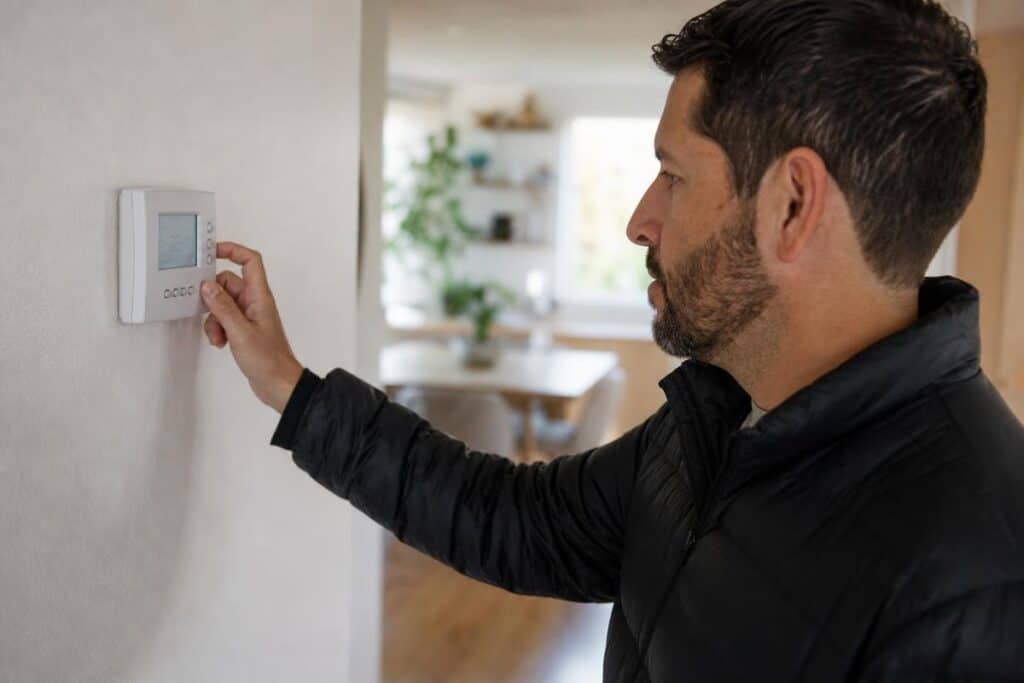
Most furnaces stop working due to a tripped breaker, dead thermostat batteries, or a clogged filter, all things you can check in under five minutes. Before you call anyone, run through the three checks below. A surprising number of the “furnace won’t turn on” calls we get from local homeowners turn out to be one of these simple issues.
Check 1: Thermostat Settings and Battery
Confirm the mode is set to HEAT, not COOL or FAN. Then check that your set point is at least 3 to 5 degrees above the current room temperature. If nothing responds, replace the batteries. Yes, dead batteries really can leave you with no heat on a cold January night.
Honeywell and Ecobee smart thermostats are common in homes across our service area. These can appear completely dead from a Wi-Fi dropout alone. Try a manual override or a quick reboot before assuming the furnace is the problem.
Check 2: The Circuit Breaker
Your furnace typically runs on a dedicated 15-amp breaker labeled “Furnace” or “Air Handler.” If it has tripped, flip it fully OFF and then back ON once. If it trips again right away, stop. That points to a wiring or motor fault. At that point, schedule a professional heating repair visit rather than resetting it again.
Check 3: Your Gas Supply
Find the shutoff valve on the gas line near your furnace. It should sit parallel to the pipe, meaning it is open. Then check another gas appliance, your range or water heater. If none of them work either, contact SoCalGas directly. That is a supply issue, not a furnace issue, and no HVAC tech can fix it from your equipment side.
Cause 1: A Dirty Air Filter Is Choking Your Furnace
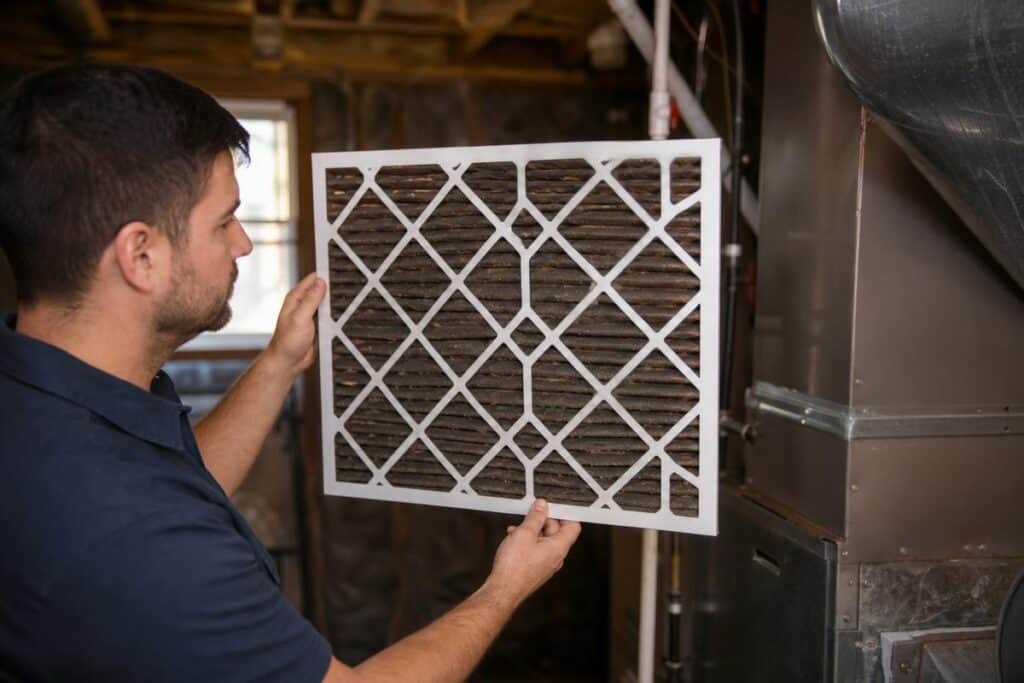
You’d be amazed how often this is the culprit. A clogged filter blocks airflow over the heat exchanger. The furnace overheats. The high-limit safety switch trips and shuts the burner off to protect itself. Now your blower keeps running, pushing cold air through the vents, and it looks like a serious mechanical problem. Often it is just an inexpensive replacement filter.
Here in the Inland Valley, filters clog faster than the box suggests. Santa Ana conditions push heavy particulate across the region, and wildfire smoke makes it worse. A standard 1-inch MERV-8 filter rated for 90 days can clog in 3 to 4 weeks during those high-particulate periods. Read our guide on preparing your HVAC system for wildfire season for more on that.
How to Check Your Filter Right Now
Find the filter slot at your air handler or return air grille. Pull the filter out and hold it up to a light. If no light passes through, replace it immediately. Do not wait.
Check 1-inch filters monthly from October through March. Four-inch media filters can go every 6 months. If your annual furnace tune-up is overdue, a filter check is part of what we do on every visit.
Cause 2: Thermostat Problems Beyond a Simple Setting Error
This one trips up a lot of homeowners. The thermostat looks fine. The display is on. But the furnace still won’t fire. The problem is often deeper than a wrong setting.
Loose Wiring at the Thermostat Terminal Board
Your thermostat communicates with the furnace through low-voltage wires, typically labeled R, W, G, and Y. The W wire is the one that sends the call-for-heat signal. If that wire is loose or corroded at the terminal board, the furnace never gets the message to turn on. We see this often in local homes where original wiring has been disturbed during a smart thermostat upgrade.
Pull the thermostat off the wall and check that each wire is firmly seated. A loose connection is a quick fix. A corroded terminal is not.
Calibration Drift and Smart Thermostat Firmware Bugs
Older bimetallic thermostats can drift 3 to 5 degrees off over time. The room feels cold, but the thermostat thinks it is satisfied. That gap means the furnace never runs long enough. Smart thermostats like Nest and Ecobee have a different issue. Power outages during those wind events can cause firmware glitches that prevent the unit from calling for heat. Try a factory reset first. Hold the thermostat ring or press the reset option in the app settings. If that does not fix it, the unit may need replacing.
When to Replace Instead of Repair
If your thermostat is more than 10 to 12 years old, has a cracked display, or shows erratic temperature swings, replacement is the smarter call. Our annual heating maintenance visit includes a full thermostat calibration check so you catch these issues before a cold night forces the issue.
Not sure if it’s your filter or something worse? Schedule a diagnostic visit and let a NATE-certified technician pinpoint the exact cause.
Cause 3: A Dirty or Faulty Flame Sensor Is Shutting Off the Burner
Here is what a dirty flame sensor looks like from the inside of a service call. The furnace fires up, runs for about 3 to 5 seconds, then shuts off. It tries again. Same thing. After three attempts, it locks out completely. That cycling pattern almost always points to one small part: the flame sensor.
The flame sensor is a thin metal rod that sits directly in the burner flame. It generates a tiny electrical current, typically 2 to 6 microamps, that tells the control board a flame is actually present. When the rod gets coated with oxidation or combustion residue, that current drops below the board’s threshold. The board reads it as “no flame” and shuts the gas valve as a safety measure. The furnace is doing exactly what it should. It just needs cleaning.
Here in Temecula, furnaces often sit unused for 8 to 9 months during our mild Southern California weather. That long idle period speeds up oxidation on the sensor rod. By the time you need heat in November, the sensor may already be too coated to read correctly.
A technician cleans the rod with fine steel wool or emery cloth. That usually restores the microamp reading right away. If cleaning does not fix it, the sensor itself is an inexpensive part. Either way, it is not a big repair. Our annual furnace tune-up service includes this inspection every visit, which is the easiest way to catch it before your furnace not working becomes a cold-night emergency in Southern California.
Cause 4: Ignition System Failures, Hot Surface Igniters and Draft Inducers
You hear the furnace try to start. The draft inducer spins up. Then nothing. No heat, no flame. This is one of the most common calls we get for a furnace not producing heat, and it almost always points to one of two wear parts: the hot surface igniter or the draft inducer system. Both are normal maintenance items, like a worn brake pad. They wear out on a schedule.
Hot Surface Igniter Failure
A hot surface igniter (HSI) is a small silicon nitride or silicon carbide element that glows orange-hot to light the gas. It is fragile and typically lasts 3 to 7 years. Many Temecula homes built during the 1990s and early 2000s residential boom are now on their second or third igniter, and units installed during later Inland Valley building phases fall right in the window for HSI failure.
When the igniter cracks or burns out, the gas valve clicks but no flame appears. A technician checks continuity with a multimeter. An open loop (OL) reading confirms the igniter is done. Replacement is straightforward. Our team handles this regularly as part of professional heating repair visits.
Draft Inducer Motor and Pressure Switch
The draft inducer motor must reach full speed before the gas valve opens. If the motor has weak bearings, a bad capacitor, or a cracked rubber pressure switch hose, the pressure switch never closes. The furnace stalls right there.
Your symptom: the inducer runs but nothing else happens. Check your control board for a flashing error code, usually 3 or 4 flashes. That points directly to a pressure switch fault. An annual furnace tune-up catches these issues before a cold night forces the call.
Hearing your furnace try to start but getting no heat? Call us at (951) 277-6848 and we’ll diagnose the igniter or pressure switch fast.
Cause 5: A Cracked Heat Exchanger, The One You Cannot Ignore
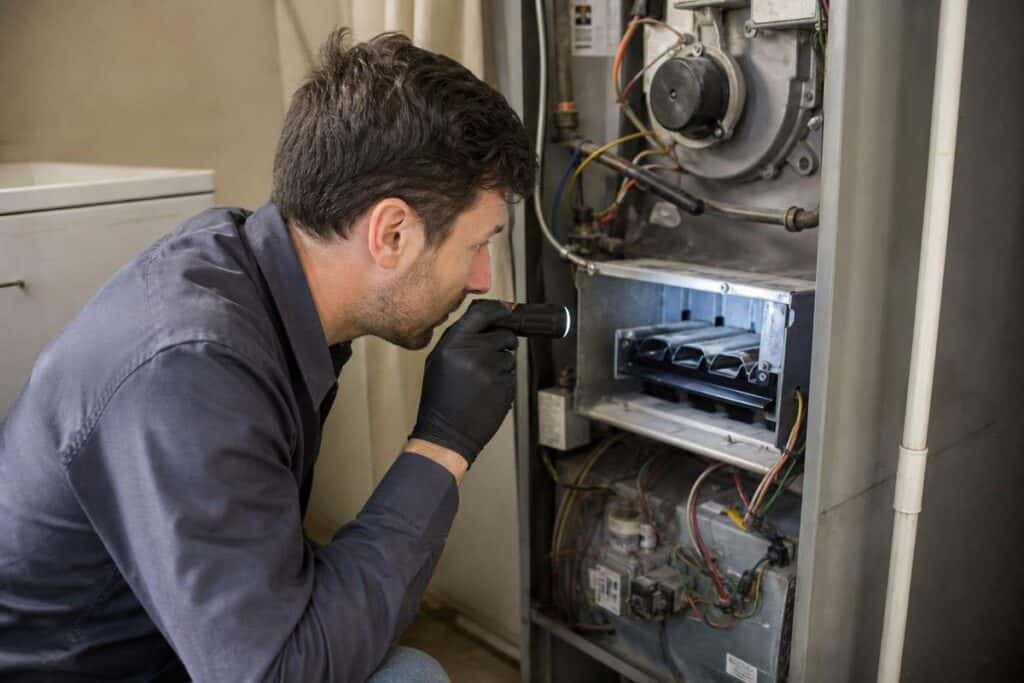
A cracked heat exchanger is the most serious furnace failure mode there is. When the heat exchanger cracks, combustion gases including carbon monoxide can mix directly with the conditioned air circulating through your home. You cannot see the crack. You cannot smell carbon monoxide. That is what makes this so dangerous.
How Cracks Form
Every time your furnace fires up, the heat exchanger expands. Every time it shuts off, it contracts. That thermal cycling stress adds up over 15 to 20 years. Furnaces in Riverside County neighborhoods run only 60 to 90 days per year, so homeowners often assume the system has low wear. It does not. The stress accumulates regardless of how short the season feels.
This matters especially in Temecula’s older housing stock from the 1990s and 2000s, where original furnaces have now cycled through two full decades of expansion and contraction. Running the furnace with a clogged filter makes this worse. Chronic overheating accelerates cracking significantly.
Warning Signs to Watch For
- A formaldehyde or exhaust smell near supply vents
- Soot marks on or around the furnace cabinet
- Unexplained headaches or nausea when the furnace runs
- A CO detector alarm
If your CO detector activates, leave the home immediately and call 9-1-1. Do not call us first. If you notice symptoms without an alarm, turn the furnace off at the thermostat and call for professional heating repair right away.
Repair or Replace?
On a furnace over 15 years old, heat exchanger replacement rarely makes financial sense. Check out the 8 warning signs your furnace needs urgent attention to help you decide. Most of the time, full furnace replacement is the smarter call.
Cause 6: An Aging Furnace That Has Simply Reached the End of Its Life
Sometimes a furnace isn’t broken. It’s just done. Most furnaces last 15 to 20 years. Many homes in the Inland Valley built during the 1990s and early 2000s residential boom are sitting on units that are now 20 to 25 years old. Those are single-stage, 80% AFUE systems. They were standard then. They’re expensive to run now.
The Repair-or-Replace Rule
Here’s the honest math. If the repair quote exceeds 50% of what a new system costs, and your furnace is past 15 years old, replacement is almost always the smarter call. Older control boards are increasingly hard to source. Paying for a part that may not exist next season is not a good investment.
A modern 96% AFUE two-stage furnace cuts your gas use noticeably, even in a short SoCal winter. That efficiency gain adds up across Riverside County’s cold overnight lows. Check our year-end HVAC maintenance checklist to track what your system has needed over time.
Signs Your Furnace Is Telling You It’s Done
- Short cycling every few minutes
- Uneven warmth from room to room
- Loud banging or rattling at startup
- A second repair needed within one season
If any of those sound familiar, it may be time to look at furnace replacement options rather than another repair bill.
When Should You Call a Professional Instead of Troubleshooting Yourself?
Call a professional the moment the problem goes beyond the basics. Replacing a filter, resetting a tripped circuit breaker, swapping thermostat batteries, and toggling the furnace power switch are all safe DIY steps. Everything else inside that furnace cabinet is a different story.
Stop and Call If You Notice Any of These
- You smell gas near the furnace or anywhere in the home
- Your carbon monoxide detector has alarmed
- The furnace cycles on and off repeatedly without warming the house
- You see cracks, soot, or scorch marks near the heat exchanger
- Any wiring, gas valve, or internal electrical component needs to be touched
Gas lines, heat exchangers, and internal electrical components are not DIY territory. A mistake there can mean carbon monoxide in your home. That is not a risk worth taking.
Why Our Credentials Matter for Furnace Repair
Our technicians are NATE-certified and have earned recognition including five Dave Lennox Award wins and the Southern California Edison Contractor of the Year award. When you need professional furnace repair, you want someone who has done this work thousands of times. Not sure what to look for in a contractor? Our guide on how to choose a qualified HVAC contractor walks you through it.
We serve the Inland Valley and Riverside County area. Hours are Monday through Friday 7am to 8pm and weekends 8am to 5pm.
How Temecula’s Climate Makes Annual Furnace Maintenance Non-Negotiable
We hear this a lot: “My furnace only runs a few months a year. Why does it need a tune-up?” Here’s the honest answer. A furnace that sits idle for 8 or 9 months doesn’t stay clean. Dust settles on burners. The flame sensor oxidizes. And when that first cold snap hits the Redhawk and Harveston corridors, overnight lows can drop into the upper 20s. That furnace fires up cold after months of rest, and thermal stress on an already-dirty system is exactly how breakdowns happen on the coldest night of the year.
Our elevation here, around 1,000 feet, means temperatures fall faster than in coastal cities. You get a warm afternoon and a brutal overnight low. Your furnace has to work hard, fast. Fall Santa Ana conditions make it worse. They push heavy particulate deep into your system, not just the filter. Read more about that in our guide on preparing your HVAC system for wildfire season.
We recommend scheduling your annual furnace tune-up in October, before the cold arrives. A proper visit covers flame sensor cleaning, igniter resistance check, burner combustion analysis, heat exchanger visual inspection, and flue venting review. Our year-end HVAC maintenance checklist walks through each step. Our VIP Club members get this on a scheduled cycle automatically, so nothing gets skipped.
Frequently Asked Questions
Why is my furnace running but not producing heat?
The blower is running but the burner is off. That usually means the high-limit switch tripped, often from a clogged filter. Check the filter first. If the filter is clean, a technician needs to pull error codes from the control board to find the real cause.
How do I reset a furnace that has locked out?
Set the thermostat to OFF. Flip the furnace power switch off. Wait 30 seconds, then restore power. If the furnace locks out again within one heating cycle, stop resetting it. Repeated resets can hide a gas or safety issue that needs a professional diagnosis.
Can I replace a furnace filter myself?
Yes, this is a safe DIY task. Note the arrow on the filter frame. It points toward the blower, away from the return duct. During wildfire season in the Inland Valley, check your filter monthly rather than every 90 days. Smoke particulates from those wind events clogs filters much faster than normal use. See our guide on preparing your HVAC system for wildfire season for more detail.
How long does a furnace last in Southern California?
Expect 15 to 20 years. Fewer annual run hours can help, but long idle periods and thermal cycling still wear components down. Any furnace over 18 years old should get an annual furnace tune-up to catch problems before they become costly.
Is it safe to run my furnace if I smell something burning?
A brief dusty smell on the first startup of the season is normal. Dust burns off the heat exchanger. A persistent chemical, metallic, or exhaust smell is not normal. Shut the furnace off and call for service right away.
How much does furnace repair typically cost in the Inland Valley?
Costs depend on the repair type, part availability, and system age. A cracked heat exchanger in an older unit often makes full replacement the smarter financial choice. You should always get a clear diagnosis and firm price before any work begins.
If you have worked through these checks and your furnace still is not responding, call our team at (951) 277-6848. We are available Monday through Friday 7am to 8pm and weekends 8am to 5pm. Our NATE-certified technicians will diagnose the problem, give you a clear price, and fix it right the first time. You can also visit us at 27720 Jefferson Ave Ste 100, Temecula, CA 92590. No pressure, no guesswork. Just a straight answer about what your furnace needs.
Ready to Get Started with We Care Plumbing, Heating and Air?
Call (951) 277-6848 to speak with our team directly. We’re ready to answer your questions, walk you through your options, and help you find the right solution for your needs. Whether you’re just starting to plan or ready to move forward, we’ll make the process simple and stress-free.
Reach out today and let’s talk about how we can help.