


If you have ever pulled your thermostat off the wall to replace it or troubleshoot your HVAC system, you have likely encountered a tangle of small colored wires tucked into the wall cavity. Each one connects to a terminal on your thermostat and carries a specific signal to or from your heating and cooling equipment. Knowing what those colors mean is useful before you attempt any kind of thermostat swap, before you call a technician for a diagnostic, or simply to understand why your system is not behaving the way you expect.
In Riverside and San Bernardino County, homeowners deal with a wide range of HVAC system ages and configurations. Older homes in cities like Fontana, Rialto, and Redlands may have two- or four-wire systems installed decades ago, while newer construction in areas like Murrieta, Temecula, and Rancho Cucamonga typically includes five-wire setups with a dedicated common wire. This guide walks through the standard thermostat wiring color codes, what each wire does, and how to safely identify yours.
Why Thermostat Wire Colors Matter
Thermostat low-voltage wiring typically runs at 24 volts AC, supplied by a transformer in your air handler or furnace. While 24 volts is not as immediately dangerous as line voltage, incorrect wiring can damage your thermostat, short out your HVAC control board, or cause your heating and cooling system to behave erratically. Color coding exists to standardize installations across the industry, though there is no universal law requiring contractors to follow any particular color scheme.
The good news is that the industry has largely converged on a common color convention for residential thermostat wiring. In practice, most systems installed in Riverside and San Bernardino County over the past 30 years follow this convention closely, though older systems or those wired by non-standard contractors may deviate from it. Knowing the conventions gives you a strong starting point when you open your thermostat and makes communication with your HVAC technician much easier.
The Standard Thermostat Wire Color Code
The following is the widely accepted color convention for residential thermostat wiring in the United States. Each wire connects to a lettered terminal on your thermostat and on your HVAC equipment.
- R wire (red): The R terminal is the power wire. It carries 24-volt AC power from your HVAC transformer to the thermostat. Some systems have two red wires labeled Rh and Rc, which separate the heating and cooling power circuits. In a single-transformer system, the Rh and Rc terminals are typically jumpered together. The red wire is the most consistently colored wire in thermostat wiring, so if you see red, it is almost always the power wire.
- C wire (blue or black): The C wire, or common wire, completes the 24-volt circuit and provides continuous power to smart and programmable thermostats. Many older homes in San Bernardino County and the Inland Empire were not wired with a C wire because older thermostats did not require continuous power. If you are upgrading to a smart thermostat and your system lacks a C wire, your HVAC technician can add one or install a C wire adapter.
- Y wire (yellow): The Y terminal controls your air conditioning compressor. When your thermostat calls for cooling, it sends a signal through the yellow Y wire to activate the outdoor compressor. In a two-stage cooling system, you may also have a Y2 wire, typically a second yellow wire, that activates the second stage of the compressor.
- G wire (green): The G terminal controls your air handler fan. When your thermostat calls for heating or cooling, the green G wire turns on the blower fan. Most thermostats also allow you to run the fan independently using the fan ON setting, which also activates through the G wire.
- W wire (white): The W terminal is the heating wire. When your thermostat calls for heat, the signal travels through the white W wire to activate your furnace, heat pump, or boiler. In two-stage heating systems, a second white wire labeled W2 may control auxiliary or emergency heat.
- O/B wire (orange or dark blue): The O and B terminals are used with heat pump systems. Heat pumps require a reversing valve to switch between heating and cooling modes. In most heat pump systems, the orange O wire energizes the reversing valve to activate cooling mode. Some older heat pump systems, particularly those made by Carrier, use a dark blue B wire that energizes the reversing valve in heating mode. If you have a heat pump, this wire is critical to configure correctly.
- E wire (brown): The E terminal controls the emergency heat setting on heat pump systems, bypassing the outdoor unit and running only the backup electric resistance heat strips in the air handler. Not all heat pump thermostats use this terminal.
- Aux wire (also sometimes white or labeled Aux): Auxiliary heat is the backup heat source on a heat pump system, typically electric heat strips in the air handler. In cold weather, when the heat pump cannot keep up with demand, the aux heat kicks in automatically. This is separate from emergency heat, which must be manually activated.
How Many Wires Does Your Thermostat Need?
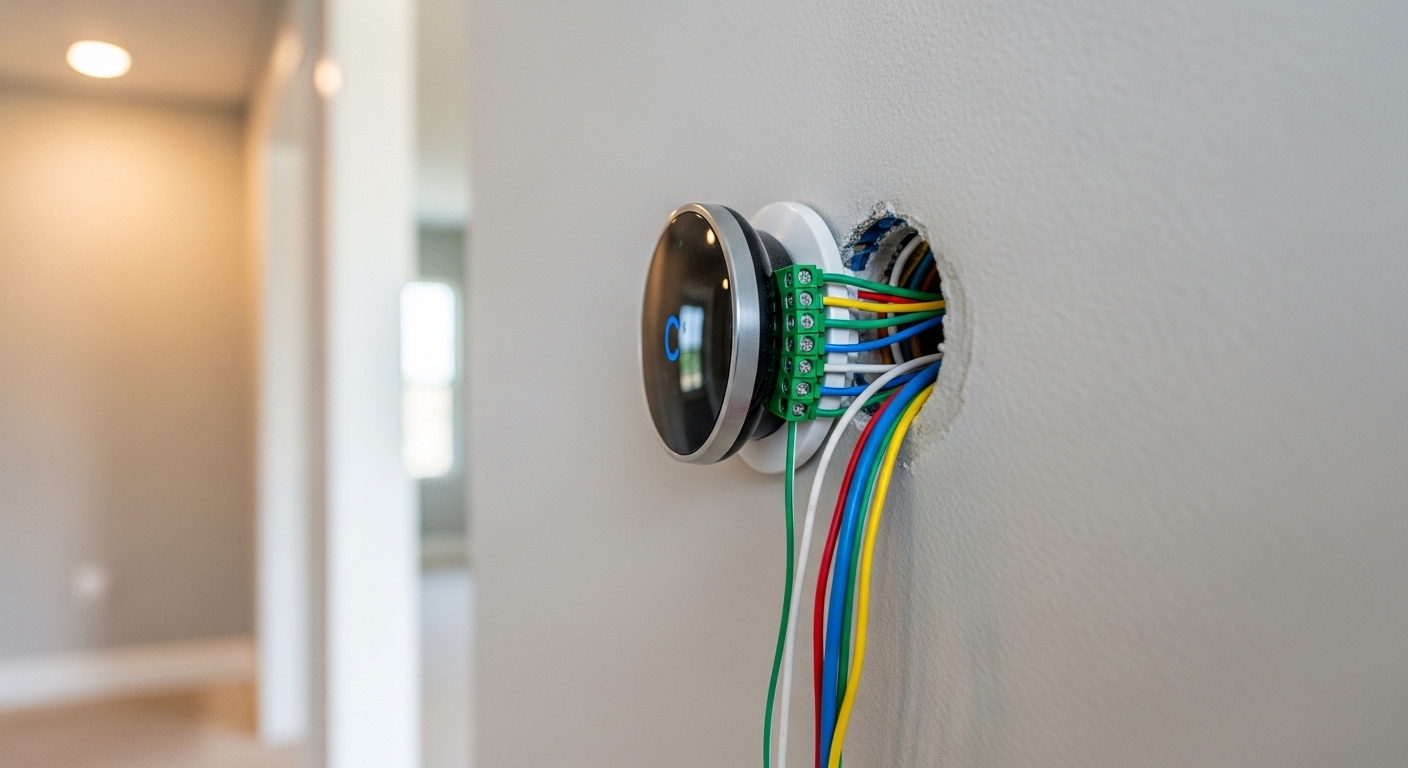
The number of wires your thermostat requires depends on your HVAC system type and the features you want. Understanding the minimum wire count for your setup helps you identify whether your current wiring supports a thermostat upgrade.
- Two-wire systems: Some older Riverside and San Bernardino County homes have just two thermostat wires, typically Rh and W, controlling a basic heating-only system like a gas furnace or boiler with no central air conditioning. These systems are simple and reliable but do not support modern smart thermostats without additional wiring.
- Four-wire systems: A four-wire setup typically includes R, G, Y, and W, providing full heating and cooling control for a standard split system. This configuration supports most conventional programmable thermostats but may not provide the continuous power modern smart thermostats require without a C wire.
- Five-wire systems: Adding the C wire gives you five conductors and enables smart thermostat installation without adapters. This is the most common configuration in homes built in Murrieta, Temecula, and other Inland Empire communities since the mid-2000s.
- Heat pump systems: Heat pump wiring typically includes R, C, Y, G, O or B, and sometimes W2 or Aux and E terminals. If you have a heat pump and are unsure how to configure these additional terminals, professional help from an HVAC technician prevents costly control board damage.
How to Safely Identify Your Thermostat Wires
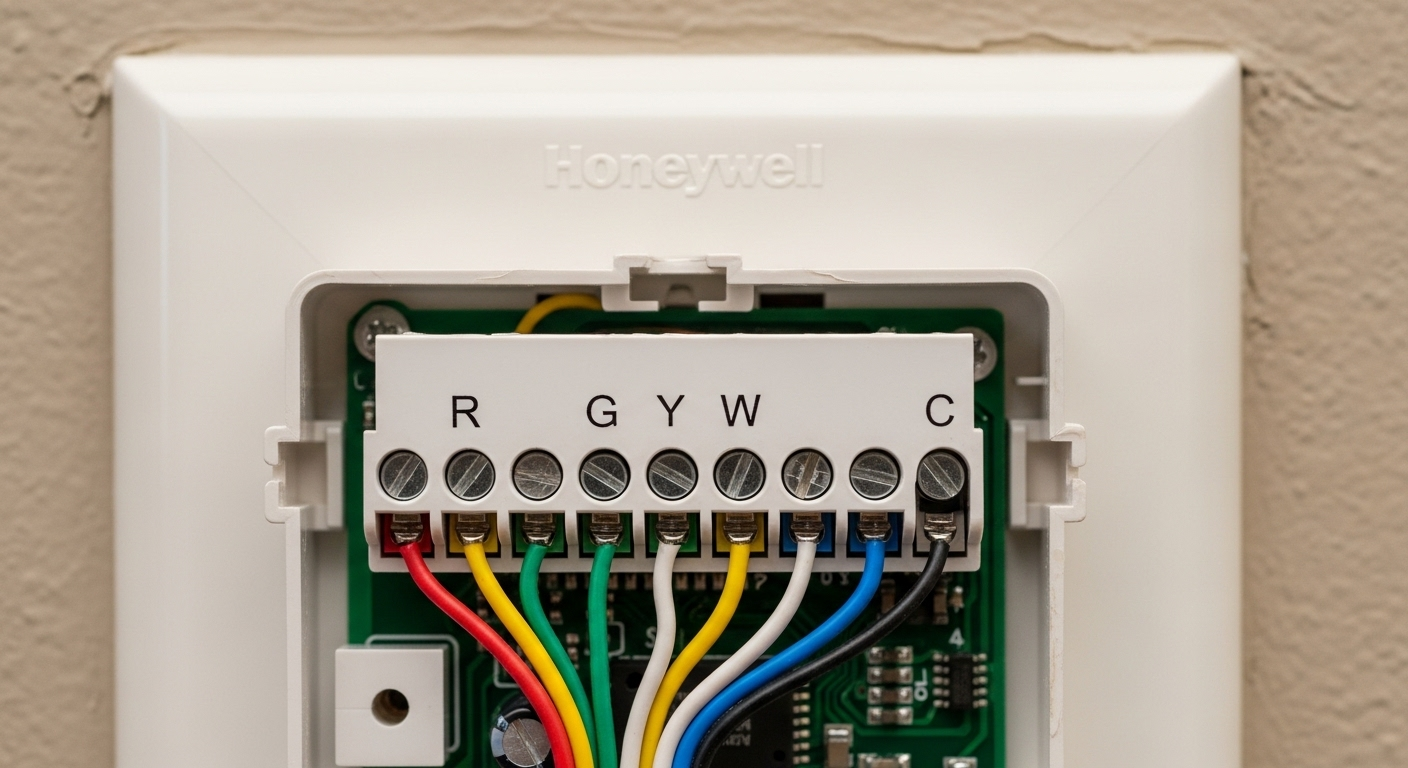
Before you remove your thermostat for any reason, take a clear photograph of the wiring panel with all wires connected and labeled. This gives you an accurate reference if wires become loose or if you need a technician’s help later.
- Step one: Turn off power to your HVAC system at the breaker before removing the thermostat. Even though thermostat wiring is low voltage, the HVAC control board can be damaged if wires short against each other during removal.
- Step two: Remove the thermostat cover and faceplate carefully. Most snap off, while others have a small screw.
- Step three: Photograph the terminal block with all wires in place before removing any wire.
- Step four: Note which letter each wire is inserted into. The terminal letters should be visible on the base plate. Compare what you see against the color code conventions described above.
If your wire colors do not match the standard conventions described above, do not assume you know which terminal a wire belongs to based on color alone. Older systems, systems installed by previous homeowners, and systems that have been serviced multiple times may have non-standard or mixed-color wiring. When in doubt, have a licensed HVAC technician identify and label your wires before proceeding.
Common Thermostat Wiring Problems in the Inland Empire
Several wiring issues come up frequently when homeowners in Riverside and San Bernardino County attempt thermostat upgrades or replacements. Understanding these problems can help you avoid them or recognize when you need professional help.
Missing C wire: This is the most common obstacle for smart thermostat installation in older Inland Empire homes. Without a continuous power source, some smart thermostats attempt to power themselves by stealing power from the R and Y terminals, which can cause the compressor to chatter or short cycle. A proper C wire installation solves this problem permanently.
Mismatched wire colors: In some older homes, the original installer used non-standard wire colors, or wires were spliced and replaced over time with whatever color was available. If your system was installed before the mid-1990s, the color coding may not match the standard convention at all. Always verify wire function against the terminal letter, not just the color.
Heat pump O/B configuration error: Heat pumps are the most common source of thermostat wiring mistakes. Getting the O/B setting wrong on a new thermostat means your system will heat when it should cool and cool when it should heat. If your heat pump is blowing warm air when you have asked for cooling, or vice versa, the O/B configuration is the first place to check.
Damaged wire insulation: Low-voltage thermostat wire runs through wall cavities and attic spaces. In older Riverside and San Bernardino County homes, these wires may have been damaged by pests, heat, or repeated use over decades. Damaged insulation can cause intermittent shorts and erratic thermostat behavior. A complete wiring inspection is sometimes necessary when troubleshooting a system that works inconsistently.
When to Call a Professional for Thermostat Wiring
Many thermostat replacements are straightforward for a homeowner who is comfortable with basic tasks. However, several situations call for professional HVAC service rather than a DIY approach.
If your system uses a heat pump, the additional terminals and the importance of correct O/B configuration make professional installation the safer choice. If your home lacks a C wire and you are installing a smart thermostat, having a technician add the wire properly is more reliable than using an adapter, which can cause compatibility issues. If your system is not working correctly after a thermostat swap, do not continue experimenting with wiring changes, as each incorrect configuration risks damaging the HVAC control board, which is an expensive repair.
We Care Plumbing, Heating and Air provides heating and air conditioning service throughout Riverside and San Bernardino County, including Murrieta, Temecula, San Marcos, Fontana, Redlands, and the surrounding communities. Call us at (760) 309-3474 if you need help with a thermostat installation or if your heating and cooling system is not responding correctly.
Frequently Asked Questions
What does the C wire do on a thermostat?
The C wire, or common wire, completes the 24-volt AC circuit that powers your thermostat. Older thermostats with batteries or simple mechanical switches did not require a C wire. Smart and programmable thermostats that need continuous power, including Wi-Fi connectivity, require the C wire to function correctly. Without it, the thermostat may struggle to stay powered or may attempt to draw current through the Y compressor wire, causing short cycling or compressor damage.
Why does my old thermostat have different wire colors than the standard?
There is no legal requirement for HVAC installers to follow any specific color code. While the industry conventions described above are widely followed, older systems, systems installed by contractors using non-standard wire, and systems that have been repaired or modified over the years may use different colors. Always verify wire function by the terminal letter it connects to rather than by color alone, especially on systems more than 20 years old.
Can I replace my thermostat myself in a Riverside or San Bernardino County home?
Yes, a standard thermostat replacement in a conventional central air system with clear labeled wiring is within the ability of most homeowners. Take a clear photo of your wiring before removing any wires, replace each wire one at a time to avoid mix-ups, and follow the installation guide for your new thermostat. However, heat pump systems, systems without a C wire, and any situation where you are unsure about wire identification are better handled by a licensed HVAC technician.
What happens if I wire my thermostat incorrectly?
Incorrect thermostat wiring can cause a range of problems depending on which wires are mismatched. Common outcomes include the system not turning on at all, the system running heating when you requested cooling or vice versa, the fan running continuously, or the system short cycling. More serious wiring errors, particularly if a wire is shorted to the R power terminal, can blow the fuse on your HVAC control board or damage the board itself. HVAC control board replacement typically costs several hundred dollars, making accurate wiring worth the investment in professional help if you are uncertain.
How do I know if my home in the Inland Empire has a C wire?
Remove your thermostat from the wall plate and count the wires connected to terminals. If you have a wire connected to the C terminal, you have a C wire. If not, look at the wire bundle coming from the wall and count the number of conductors. If you have five or more conductors but only four are connected to terminals, there is likely an unused C wire tucked into the wall cavity. Pull it out gently, strip the insulation if needed, and connect it to the C terminal. If you only have a two- or four-conductor cable, adding a C wire requires running new wire or using a C wire adapter. An HVAC technician can assess your options quickly.
About We Care Plumbing, Heating and Air
We Care Plumbing, Heating and Air has been serving Southern California homeowners with trusted plumbing, heating, and air conditioning services for over 25 years. Our licensed technicians serve Murrieta, Temecula, San Marcos, Orange County, and communities throughout San Diego County and the Inland Empire, including Riverside and San Bernardino County. We are available 24 hours a day, seven days a week for heating and air conditioning emergencies.
Call We Care at (760) 309-3474 or visit wecareteam.com to schedule service today.